The Moving Shoreline of 02633
Anyone who lives on Cape Cod knows that the map we look at today is not the map that will exist in fifty years. The sea is constantly reshaping our shores, taking sand from one beach and depositing it on another. Nowhere is this struggle between human engineering and the Atlantic Ocean more legendary than at the Chatham Lighthouse.
The Original Twin Sentinels
First established in 1808 under President Thomas Jefferson, the Chatham Light station was built on a high bluff overlooking the ocean. Because Chatham's waters were historically some of the most dangerous on the entire Atlantic seaboard, the station was built with twin wooden towers.
Interestingly, those original 1808 towers were built on massive wooden skids. Even back then, engineers knew the sandbars would shift, and the lights had to be physically moved by oxen to keep them lined up with the shifting harbor channels.
The Storm of 1870: When the Bluff Began to Crumble
By 1841, those wooden towers had decayed and were replaced by heavy brick structures. Prior to the massive winter storm of November 1870, these towers sat comfortably more than 228 feet back from the edge of the 50-foot bluff.
But the sea had other plans. The storm tore through the protective outer sandbars, redirecting the full force of the ocean directly at the foot of the lighthouse bluff. Within just a few years, the 228-foot buffer zone was completely eaten away. By 1877, the edge of the cliff was just 48 feet from the heavy brick towers.
A Planned Coastal Retreat
Recognizing that the old brick towers were doomed, the government acted fast. They purchased land directly across the street—much further inland—and constructed two new, 48-foot cast-iron towers in 1877.
It was a race against time, and the ocean won the first round. On December 15, 1879, local fishermen placed bets on when the old abandoned south tower would succumb. At 1:00 PM, the edge of the bluff gave way, and the heavy brick tower tumbled down onto the beach below. Within months, the keeper's house and the north tower followed it into the surf.
One Tower, Two Towns
The story doesn't end there. In 1923, the U.S. Lighthouse Service decided that operating twin lights in Chatham was no longer necessary. The remaining northern cast-iron tower was carefully dismantled, loaded onto a transport, and moved 12 miles north to Eastham.
Today, that relocated Chatham tower is known as the iconic red & white Nauset Light. (And yes, in 1996, Nauset Light had to be moved again to save it from the eroding Eastham cliffs!)
The Legacy Today
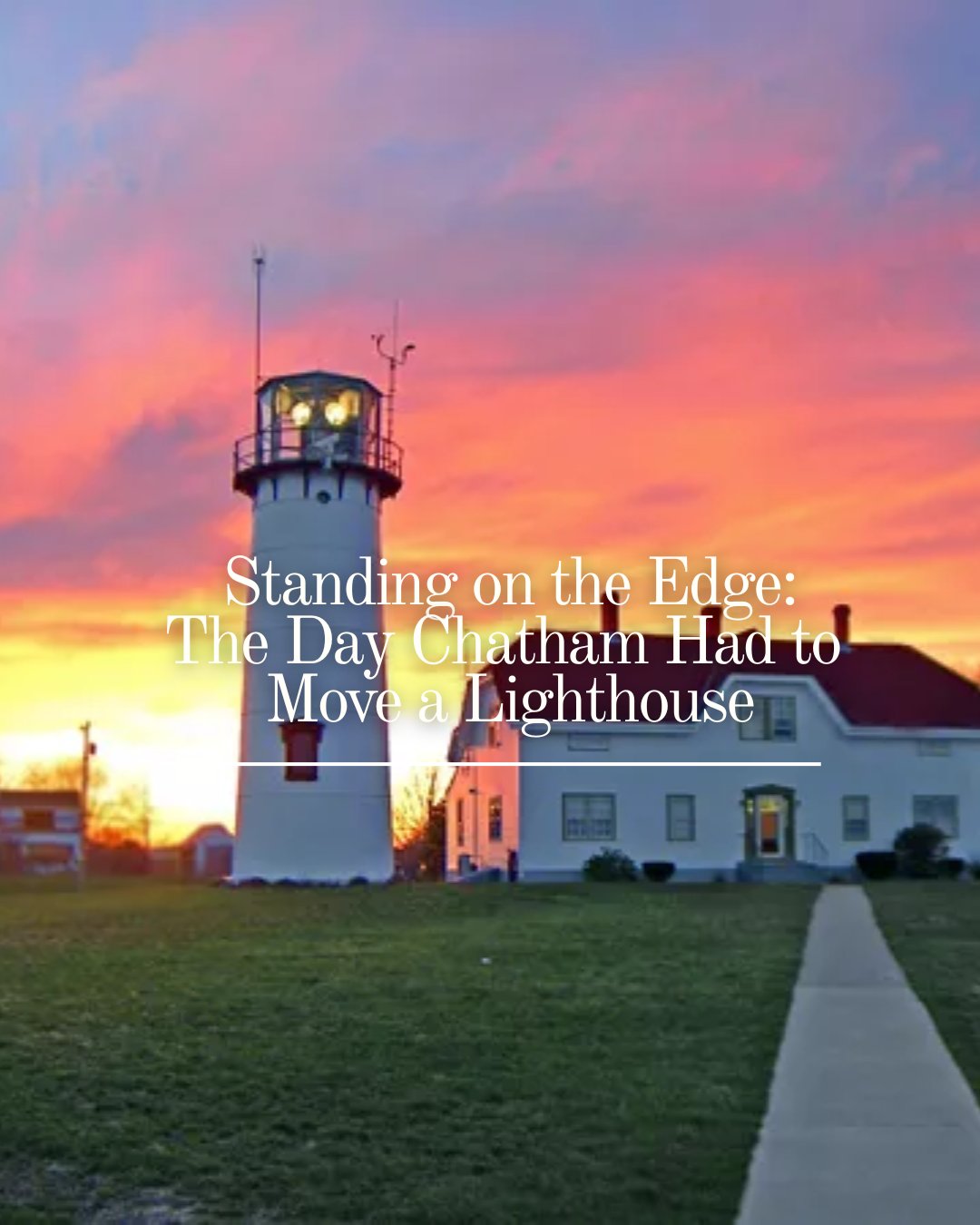
The southern tower of the 1877 pair still stands proud on Main Street in Chatham, operating as an active Coast Guard station. It is a daily reminder of our town's rich maritime history and a beautiful symbol of why we respect the power of the sea.
Living on the Cape means embracing this dynamic, ever-changing environment. If you're looking for a home in Chatham that offers a front-row seat to our rich history, with a careful eye on the local topography, I'm always here to help you navigate the landscape.